CoD MW4 Decoy Grenade and Its Tactical Role in Multiplayer
Tactical equipment can change the course of a firefight before either side lands a shot. When comparing CoD MW4 DMZ Items, it is important to distinguish equipment designed for direct combat from tools built around deception and battlefield awareness. The Decoy Grenade belongs to the latter category in Modern Warfare 4 multiplayer, simulating gunfire, movement, and radar signatures to confuse opponents. Its greatest tactical value lies in influencing enemy decisions, creating opportunities for coordinated movement, and making contested areas more difficult to read.
How the Decoy Grenade Works
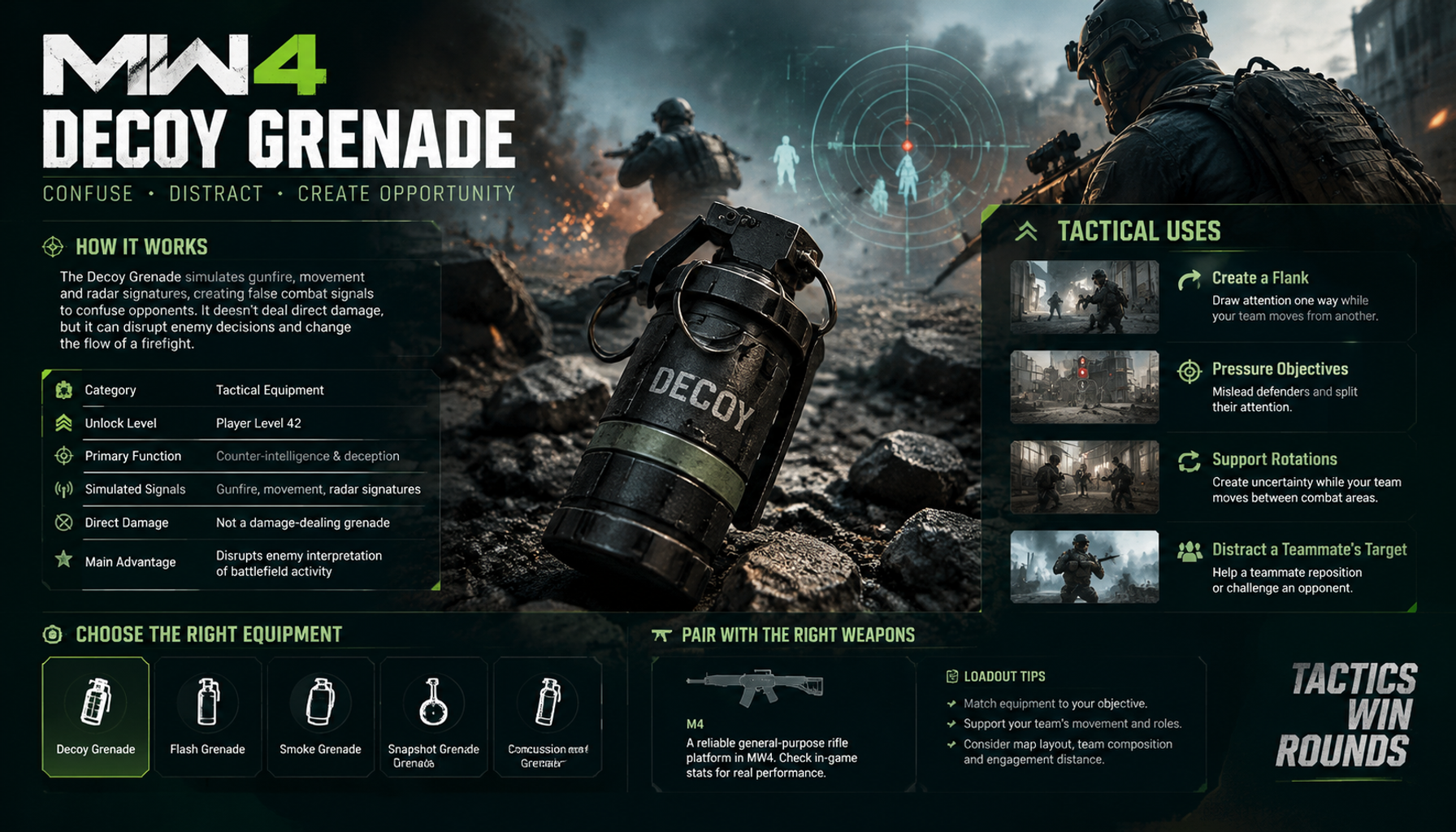
The Decoy Grenade is Tactical Equipment that unlocks at Player Level 42 in MW4 multiplayer. Its counter-intelligence function creates misleading combat signals rather than dealing direct damage. When opponents rely on audio cues and radar information to assess nearby threats, false signals can complicate their decisions about positioning and movement.
The grenade does not guarantee that an enemy will leave cover or abandon an objective. Experienced opponents may recognize suspicious activity, while coordinated teams can use visual information and communication to avoid reacting to every signal. Successful deployment therefore depends on timing and the action that follows.
The distinction between the Decoy Grenade and the Inflatable Decoy is also important. The former is Tactical Equipment that simulates combat activity, while the latter is a deployable decoy dummy classified as a Field Upgrade. They serve different functions and should not be treated as interchangeable items.
| Equipment Detail | Confirmed Information |
|---|---|
| Equipment category | Tactical Equipment |
| Unlock level | Player Level 42 |
| Primary function | Counter-intelligence and deception |
| Simulated signals | Gunfire, movement, and radar signatures |
| Direct damage role | Not designed as a damage-dealing grenade |
| Main tactical advantage | Disrupting enemy interpretation of battlefield activity |
Tactical Uses in Multiplayer
Creating an Opening for a Flank
A decoy can help draw attention toward one approach while teammates prepare to move through another. On maps with multiple lanes, this creates an opportunity to challenge opponents from an unexpected angle rather than entering a defended position directly.
Timing is essential. Deploying the grenade too early may give opponents enough time to investigate and return to their original positions before the flank arrives. A coordinated push makes the distraction more meaningful because the team can capitalize on the uncertainty while it lasts.
Applying Pressure Around Objectives
Objective-based modes reward teams that control space and force opponents to divide their attention. A Decoy Grenade can introduce misleading signals near one approach, potentially encouraging defenders to check a different lane while teammates pressure the objective.
This tactic is most effective when the team understands the objective’s layout and has a clear follow-up plan. A distraction without coordinated movement rarely creates a lasting advantage. If the opposing team maintains overlapping sightlines and communicates effectively, the decoy may have little impact.
Supporting Rotations Between Combat Areas
Moving between objectives can expose players to opponents watching predictable routes. A decoy can help create uncertainty around one approach while teammates rotate through a safer alternative.
Before committing to the movement, consider the available cover, enemy sightlines, and the time needed to reach the next position. Misleading information can influence an opponent’s attention, but it cannot protect a player crossing an exposed lane.
Drawing Attention Away From a Teammate
In coordinated matches, one player can create a distraction while another changes position or prepares to challenge an opponent. This approach works best when both players understand the timing and intended direction of the play.
A decoy should not be treated as a substitute for communication. If teammates interpret the situation differently, the distraction may separate the squad instead of creating a useful opening.
Choosing Equipment for Different Situations
The Decoy Grenade is only one part of a multiplayer loadout. Other Tactical Equipment options address different problems, including impaired enemy vision, blocked sightlines, and information gathering.
| Equipment | Primary Function | Tactical Application |
|---|---|---|
| Decoy Grenade | Simulates combat activity | Creates misleading signals and supports deception |
| Flash Grenade | Blinds and disorients opponents | Helps create an opening during a direct engagement |
| Smoke Grenade | Obscures vision | Reduces exposure when crossing visible lanes |
| Snapshot Grenade | Briefly reveals nearby enemies | Supports threat assessment before an entry |
| Concussion Grenade | Disrupts enemy movement and reactions | Helps pressure opponents during an assault |
The right choice depends on the immediate objective. A Flash Grenade provides direct disruption, while a Smoke Grenade addresses visual exposure. A Snapshot Grenade supports reconnaissance, whereas the Decoy Grenade attempts to influence how opponents interpret battlefield activity.
Players researching the best MW4 Tactical Equipment for multiplayer should consider map layout, team composition, and preferred engagement distance. Equipment is most valuable when it addresses a specific tactical need rather than being selected simply because its effect appears powerful.
Coordinating Equipment With Weapon Roles
Tactical equipment becomes more effective when it complements the weapons and movement patterns used by the team. A player holding a medium-range lane can provide cover while a teammate advances, while a close-range specialist can prepare to clear confined spaces after the distraction creates an opening.
The M4 offers a useful example of a familiar general-purpose rifle platform within the Call of Duty series. However, weapon statistics and performance should be assessed using MW4’s own in-game information rather than assumptions based on previous titles.
A balanced loadout should support a consistent plan. Players who intend to pressure objectives need equipment that helps them manage enemy attention and approach routes. Those focused on holding defensive positions may gain more value from tools that reveal nearby threats or disrupt an incoming assault.
Common Mistakes When Using the Decoy Grenade
A Decoy Grenade can lose its value when its deployment is disconnected from the team’s broader strategy. Several mistakes are particularly costly in competitive multiplayer.
- Throwing the grenade without planning a follow-up movement or attack.
- Repeating the same distraction from predictable positions.
- Treating simulated radar signals as proof of an actual enemy location.
- Ignoring genuine audio and visual information while focusing on the decoy.
- Expecting a distraction to overcome poor positioning or an exposed approach.
The most reliable approach is to use the grenade as one part of a larger tactical decision. Players should continue tracking confirmed enemy positions, watching likely approaches, and communicating with teammates. A misleading signal can create uncertainty, but converting that uncertainty into an advantage requires sound judgment and precise execution.
Final Thoughts
The Decoy Grenade adds a deception-focused option to MW4 multiplayer, offering opportunities to support flanks, influence objective defense, and coordinate movement around contested areas. Players evaluating CoD MW4 DMZ Items should distinguish multiplayer equipment from the separate DMZ inventory and progression systems before choosing gear for a particular mode. For those looking to buy CoD MW4 DMZ Items, U4GM provides a place to review available listings. Ultimately, understanding each item’s confirmed function and matching it to a clear tactical objective will contribute more to a consistent loadout than relying on misleading signals alone.